Our 360° greenhouse control is linked to parameters that you select to set up your basic settings. That frees time and resources for processes which must be done manually. Working with vegetables means that you typically have long production times – so why not automate where it’s possible and ease work procedures?
DGT by Senmatic delivers the market’s best flexible irrigation and fertilizer system, effective LED grow lights, and stable electronic climate controls that are easy to use and designed to operate as a fully integrated part of modern greenhouse environments and commercial vegetable production equipment.

Manual operation of irrigation and fertilizer is a time-consuming to-do if you want to ensure that all plants receive water and fertilizer in the correct dosages at the right time. Without full control of irrigation and fertilization, you risk poorer yields and unstable plant quality. Not least, you are likely to use unnecessary resources and, consequently, incur unnecessary costs, too.
Modern greenhouse automation plays a vital role in reducing waste and improving efficiency, which is why many rely on sustainable cultivation equipment for vegetable growers to support responsible and efficient production.
Through continuous innovation, Senmatic contributes to the United Nations’ Sustainable Development Goals by helping growers optimize resource use and support more sustainable food production.
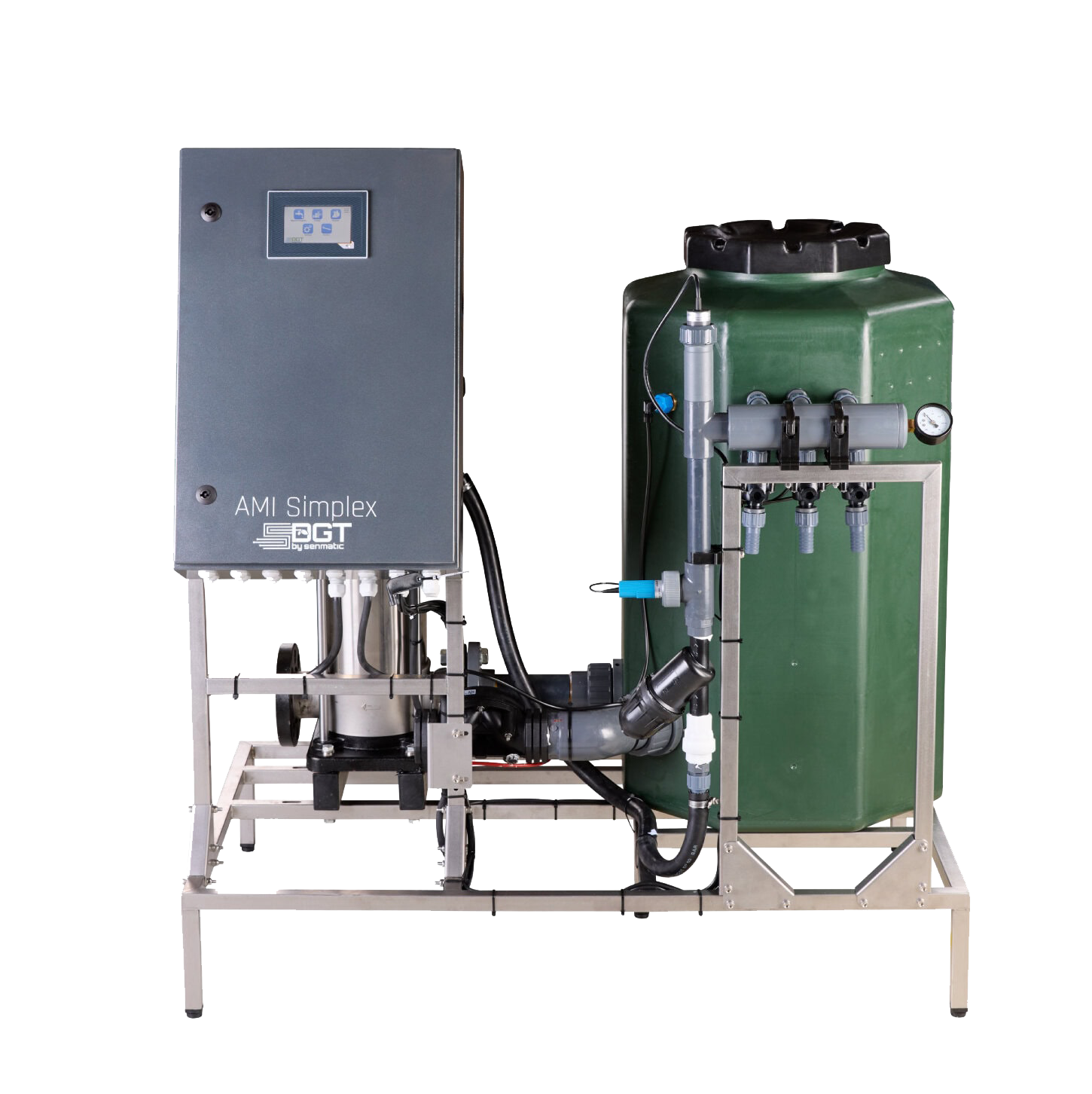
If you already have an Irrigation and Fertilizer Mixer from DGT by Senmatic, a number of sensor solutions can be connected to your system. These include solar radiation sensors and drain sensors – and EC sensors for the latter of the two. By using data from the sensors, you can automate your irrigation system, making it conduct pre-selected tasks as sensors register specific values. If a sensor registers a given variable, it sends a signal to the mixer asking it to set a chosen action into motion.
This level of automation ensures precise coordination between irrigation, climate, and other commercial vegetable farming equipment, including setups using organic vegetable farmer tools, ensuring stable crop growth and efficient resource use.

You could, for example, ask your system to control irrigation based on live data on the solar radiation of the day: Let’s say your system starts at dawn and solar radiation data signals begin. When the sun shines enough to reach your maximum set point, it sends a signal to the mixer to start irrigation, while also re-starting the data summation. At the same time, your climate control can control your grow lights, either completely turning them off or turning down the light intensity to minimize use of electricity, while higher powers provide plenty of sunlight. If weather shifts to sudden rain and cloudy skies, the climate control will continuously register the live data from the sensors and the registrations in the greenhouse and will again turn on the grow lights.
Simply put: You make sure that your cultures thrive without using unnecessary resources. That’s a plus for both your economic and environmental reports. As a part of the Indutrade group, Senmatic operates in accordance with the Code of Conduct applying to the whole group, ensuring responsible business practices and reliable partnerships across the entire value chain.

In vegetable production, not only grow lights, but also heat is a critical factor. We know that if you produce tomatoes, for example, it is particularly important that the top heating is correct. That’s why we also know that you probably have some concerns when it comes to LED grow lights, as they do not emit as much heat as HPS fixtures.
In that case, we recommend a hybrid solution. In a hybrid solution, HPS and LEDs are combined and placed in a staggered formation in the production area. By doing so, you get the benefits from LED, such as controllable spectral distribution (the percentage of blue light) and light intensity, while maintaining some HPS fixtures to emit heat. These lighting and control solutions integrate seamlessly with other equipment for vegetable farming. It is, of course, also possible to install a full LED grow light solution.
Read the case
The cucumber plants at the Danish nursery Klarskov Gartneri are well off under the new grow lights from DGT by Senmatic. From harvesting two cucumbers a week per square meter during winter, the nursery now harvests two cucumbers a day per square meter after having installed LED grow lights. Cucumber production in Denmark does not normally include grow lights.
But after several stays at nurseries abroad, where Mads Klarskov, grower and owner at Klarskov Gartneri, experienced and tested production with LEDs and adjustments in spectral distribution, the family-owned nursery Klarskov Gartneri decided to investigate whether LED grow lights could be beneficial in its cucumber production in Denmark.
Read the caseContact a specialist from DGT by Senmatic to get tailored guidance for your horticultural department. Our team of experts are ready to help you optimize your nursery with sustainable technology solutions.